

Second Cyber FCA Settlement in Ten Days: Johnson Controls' $5M Case Shows Enforcement Reaches Beyond Traditional Defense Contractors
On November 13, 2026, the Department of Justice (DOJ) announced that Johnson Controls, Inc., of Milwaukee, Wisconsin, and two subsidiaries agreed to pay $5 million to resolve False Claims Act (FCA) allegations that they failed to meet the cybersecurity requirements in their federal contracts and subcontracts.
This is the second cybersecurity FCA settlement DOJ has announced this month, ten days after the $13 million ILC Dover settlement. Similar to the ILC Dover case, this settlement agreement began as whistleblower (qui tam) lawsuits. One of the whistleblowers, Kelly Vance, a former Johnson Controls employee, will receive $850,000 of the recovery. Of the $5 million, about $2.43 million is identified as restitution.
However, while ILC Dover makes aerospace and defense products, Johnson Controls is a heating, ventilation, and air conditioning (HVAC) supplier and not the kind of company most people picture when they think of a defense contractor. The same cybersecurity requirements to protect unclassified information applied to its contracts, and this latest settlement shows that enforcement is not limited to certain types of defense contractors.
Recommended reading

ILC Dover's Record $13M Cyber False Claims Act Settlement Shows Where Self-Attestations Can Go Wrong
What did DOJ allege against Johnson Controls?
DOJ alleged that from January 2018 to August 2025, Johnson Controls held contracts and subcontracts with NASA and the Departments of Defense, Energy, and Justice that required it to protect government information, and that it did not fully implement the required security controls. The settlement agreement covers 25 contracts or subcontracts and lists the Air Force, Army, and Navy among the affected agencies. The alleged gaps included:
1. Access to protected information was not controlled
Each contract involved protected information, including controlled unclassified information (CUI) and Department of Energy Official Use Only information, and required restrictions on who could access it. Johnson Controls allegedly failed to control that access because it lacked sufficient information about its own information systems and sufficient control over them.
2. No system security plan that fully met contract requirements
Many of the contracts incorporated DFARS 252.204-7008 or 252.204-7012, which require compliance with NIST SP 800-171. Johnson Controls allegedly did not have a system security plan (SSP) that fully met those requirements. The agreement describes what an SSP needs to contain: system boundaries, environments of operation, how each security requirement is implemented, and connections to other systems, in enough detail for the system to be assessed.
3. Plans of action and milestones were not fully developed or implemented
Johnson Controls allegedly did not adequately document, fully develop, or fully implement a plan of action and milestones (POA&M) to correct deficiencies and reduce vulnerabilities in its systems.
Is cybersecurity False Claims Act enforcement picking up?
It appears to be, although the numbers are still modest. Two settlements in ten days is unusual for this area of enforcement, and at least four cybersecurity FCA settlements involving federal contractors have been announced in 2026, including LOGZONE in June and Honeywell Aerospace earlier in the fall.
What’s more striking than the timing of these two November settlements is that they share the same core allegations but involve different kinds of companies and federal agencies.
Both DOJ’s announcement also places the Johnson Controls case in a broader enforcement effort. It notes that the administration launched a Task Force to Eliminate Fraud and a National Fraud Enforcement Division this year, and says FCA matters will remain at the forefront of that work.
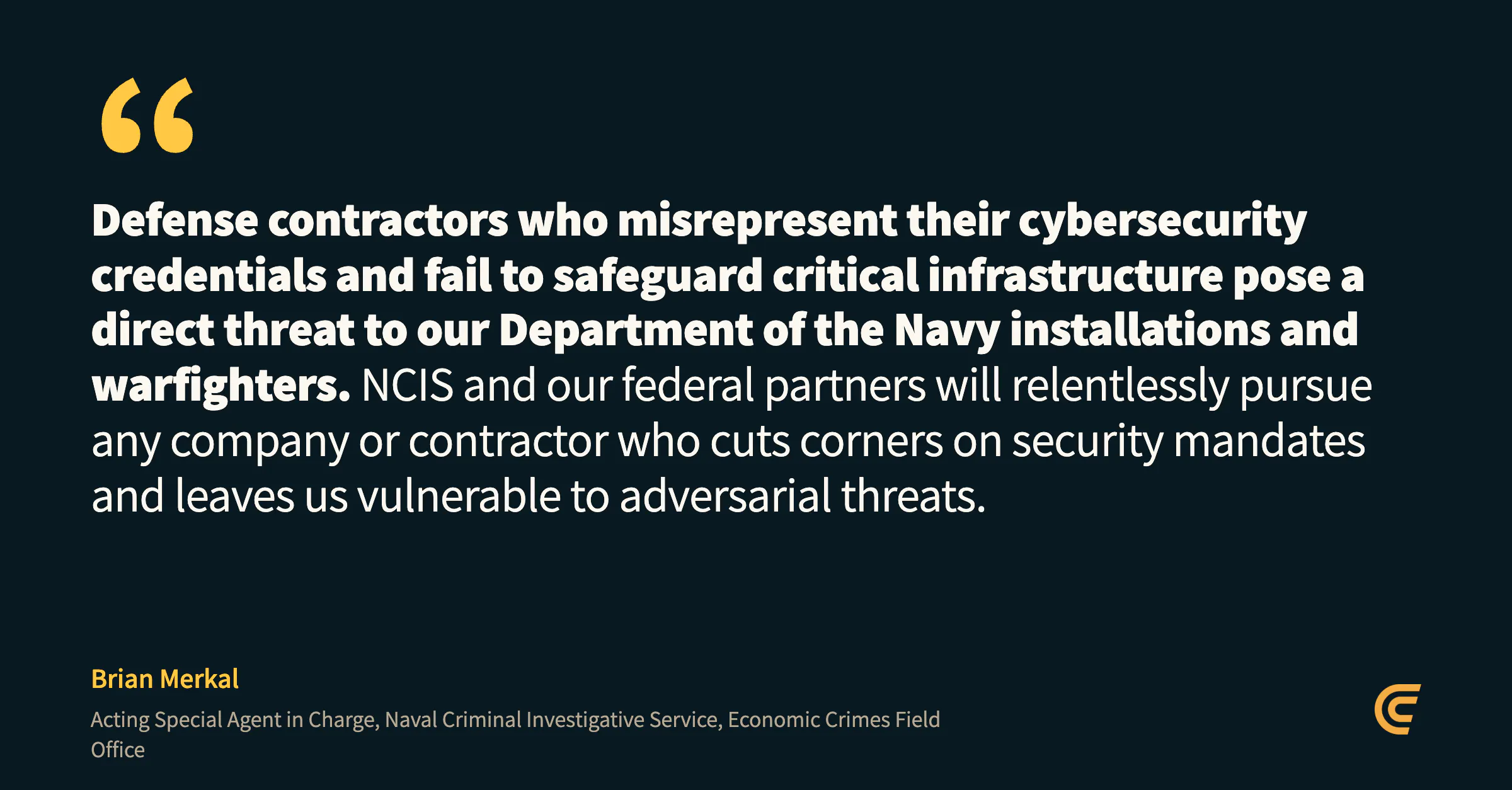
The officials quoted in both DoJ announcements also made the same argument for enforcement: these requirements exist to protect national security so compliance should not be treated as a checkbox exercise. In the Johnson Controls announcement, they described noncompliance as a threat to Navy installations and warfighters, to NASA’s operations, and to the nation’s exposure to attacks and exploitation by adversaries. That’s why, as Defense Criminal Investigative Service Director James Ives put it, “Cybersecurity requirements in federal contracts are not optional.”
This is the same reasoning behind CMMC. DFARS 252.204-7012 required contractors to implement NIST SP 800-171 by December 31, 2017, but it relied on contractors to essentially self-attest to their own compliance by signing a contract. The Department of Defense created CMMC in large part because that “trust but verify later” model was not working, and it wanted a way to verify implementation of these underlying cybersecurity requirements.
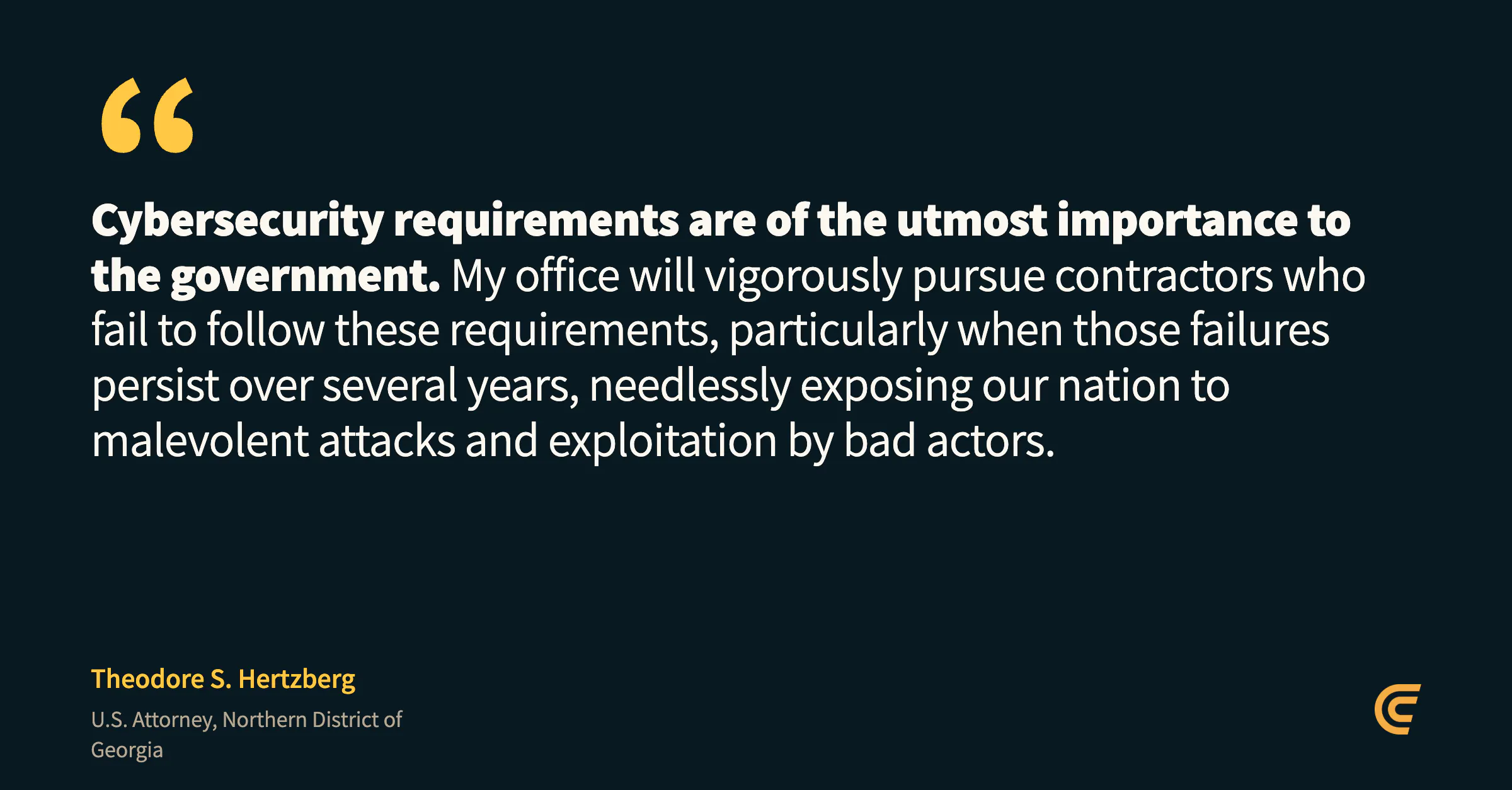
These two cases show what that self-attestation gap can look like. Both alleged periods begin in January 2018, the month after the NIST SP 800-171 deadline, and the failures allegedly persisted for roughly seven years for both companies. In other words, the allegations of non-compliance cover almost the entire period in which self-attestation was the primary check. The U.S. Attorney in the Johnson Controls case pointed to that persistence specifically, saying his office will pursue contractors with particular vigor when failures continue over several years.
Two cautions are worth keeping in mind. First, the timing can be misleading. Vance's lawsuit was filed in June 2024, almost two and a half years before the settlement was announced, so the cases resolving now reflect complaints filed years ago.
Second, the scale of FCA enforcement is still relatively small. This is the 18th settlement under DOJ's Civil Cyber-Fraud Initiative since 2021 across a Defense Industrial Base of hundreds of thousands of companies.
So the stronger reasons to get secure and stay compliant are still contract eligibility, prime contractor expectations, data protection, and operational resilience. What these two settlements add is evidence that the accuracy of a company's compliance records is being examined, and that the examination is not limited to traditional defense firms.
What the Johnson Controls settlement signals to non-traditional defense contractors
The requirements at issue attach to the information a company handles, not to the industry it is in. A company that installs and services building systems on federal sites can receive, store, or generate CUI in the course of that work. When it does, DFARS 252.204-7012 and NIST SP 800-171 apply to it in the same way they apply to a weapons or aerospace manufacturer.
Below are six key takeaways and practical steps that contractors can learn from this case:
1. Subcontracts were included
The allegations cover subcontracts as well as prime contracts. These requirements flow down the supply chain, which is one reason prime contractors are asking suppliers for proof of compliance. Companies whose federal work is a small part of a larger commercial business may want to start by identifying which contracts and subcontracts include DFARS 252.204-7012, and whether the teams that support them know it.
Recommended reading

Who Needs CMMC? Defense Contractor Requirements in 2026
2. Four departments and agencies were involved
Only some of the contracts were with the Department of Defense (DoD). NASA, the Department of Energy, and the Department of Justice each set their own information security terms, and the proposed FAR CUI rule would extend similar requirements across civilian agencies. A contract review that only looks for DFARS clauses can miss these, so it is worth checking civilian agency contracts for their own security terms as well.
3. No CMMC assessment was involved
The alleged conduct ended in August 2025, before CMMC Phase 1 began, and none of it depended on a third-party assessment. As with ILC Dover and Honeywell Aerospace, the government relied on existing contract clauses and the FCA. The Phase 2 pause does not change those clauses, which means your self-assessment and SPRS score still need to be current and accurate today.
4. The access control gap started with not knowing the systems
The access control allegation rests on a lack of sufficient information about, and control over, the company's own systems. That is a scoping problem before it is a controls problem. Mapping where CUI and other protected information is stored, processed, and transmitted, and who can reach it, is the starting point for everything else. This guide to CMMC scoping and your CUI boundary walks through how to do that.
5. The SSP existed but was not complete enough
Johnson Controls was not alleged to have no SSP at all. The allegation is that its SSP did not fully meet the contract requirements. A plan that leaves out system boundaries, connections to other systems, or how each requirement is actually implemented may not hold up if it is ever examined. If yours needs work, run or refresh a gap analysis against NIST SP 800-171 Rev 2 and use this CMMC SSP template as a starting point.
6. The POA&M was not carried through
The agreement uses three verbs for the POA&M: document, develop, and implement. Listing a gap is the first step. Each open item also needs an owner, a date, and evidence that the work is being done, because an item that sits open for years can become part of the record against you.
Not sure where your cybersecurity stands?
Take the CMMC Gap AssessmentWhere to start
Like the ILC Dover settlement, this one is not a reason for alarm. It is a reminder that federal cybersecurity requirements reach further into the supply chain than many companies assume, and that they remain in force while the CMMC rollout is paused.
Both settlements this month also began with insiders, so it helps to give employees a clear way to raise cybersecurity concerns and to document how each one is resolved.
If you want a second set of eyes on whether your scope, SSP, and self-assessment would hold up, talk to a CMMC expert.